I’ve spent the last few tax seasons wrestling crypto transactions into spreadsheets, and every year I swore there had to be a faster way. This time I put Blockstats through a full run — connecting wallets, importing exchange history, and generating IRS forms — to see whether its “file in under 30 minutes” claim actually holds up. Here’s my honest take.
1. What Is Blockstats?
Blockstats is a cryptocurrency tax software and portfolio tracker. You connect your wallets and exchanges, and it pulls in your transaction history, auto-categorizes activity with AI, tracks cost basis across wallets, and produces real-time tax forms — including IRS Form 8949, Schedule D, and TurboTax-ready exports. Alongside the filing tools it offers live portfolio tracking with performance and analytics. The company says it’s a global team of 21 crypto experts, engineers, and tax professionals, with 5,000+ users and over $100M in crypto assets tracked.
2. Who Is Blockstats Best For?
✅ Active traders drowning in transactions
If you trade across several exchanges and wallets, manual reconciliation is brutal. Blockstats’ automatic import and AI categorization is where it earns its keep.
✅ DeFi and multi-wallet users
Tracking original cost basis as assets move between wallets is exactly the messy problem this tool is built to solve.
✅ Accountants and tax professionals
There’s a dedicated accountant workflow with bulk reconciliation and cleanup tools aimed at scaling a practice without scaling the workload.
❌ People with a couple of simple buy-and-hold trades
If you made two transactions all year, the free tier or a basic manual entry may be all you need.
❌ Anyone expecting tax advice
This is software that prepares forms from your data — it’s not a substitute for a professional reviewing your specific situation.
3. Core Features Breakdown
3.1 Wallet & exchange connections
You link your wallets and exchanges and Blockstats imports the full transaction history so you’re not copy-pasting CSVs by hand.
3.2 AI transaction categorization
Transactions are auto-sorted using AI, which the company claims hits around 95% accuracy. It handles the tedious classification that eats hours in a spreadsheet.
3.3 Real-time tax forms
It generates IRS-compliant Form 8949 and Schedule D and exports to TurboTax, so the output plugs straight into your filing flow.
3.4 Portfolio tracking & analytics
Beyond tax season, you get live portfolio tracking with performance and analytics, plus cost-basis tracking across wallets and exchanges.
4. Pricing
Blockstats offers a free tier and paid plans priced per tax year, based on transaction volume. Here’s what I saw on the site:
- Free — $0, includes a free report to preview your numbers before paying.
- Basic — $69
- Plus — $119
- Pro — $169
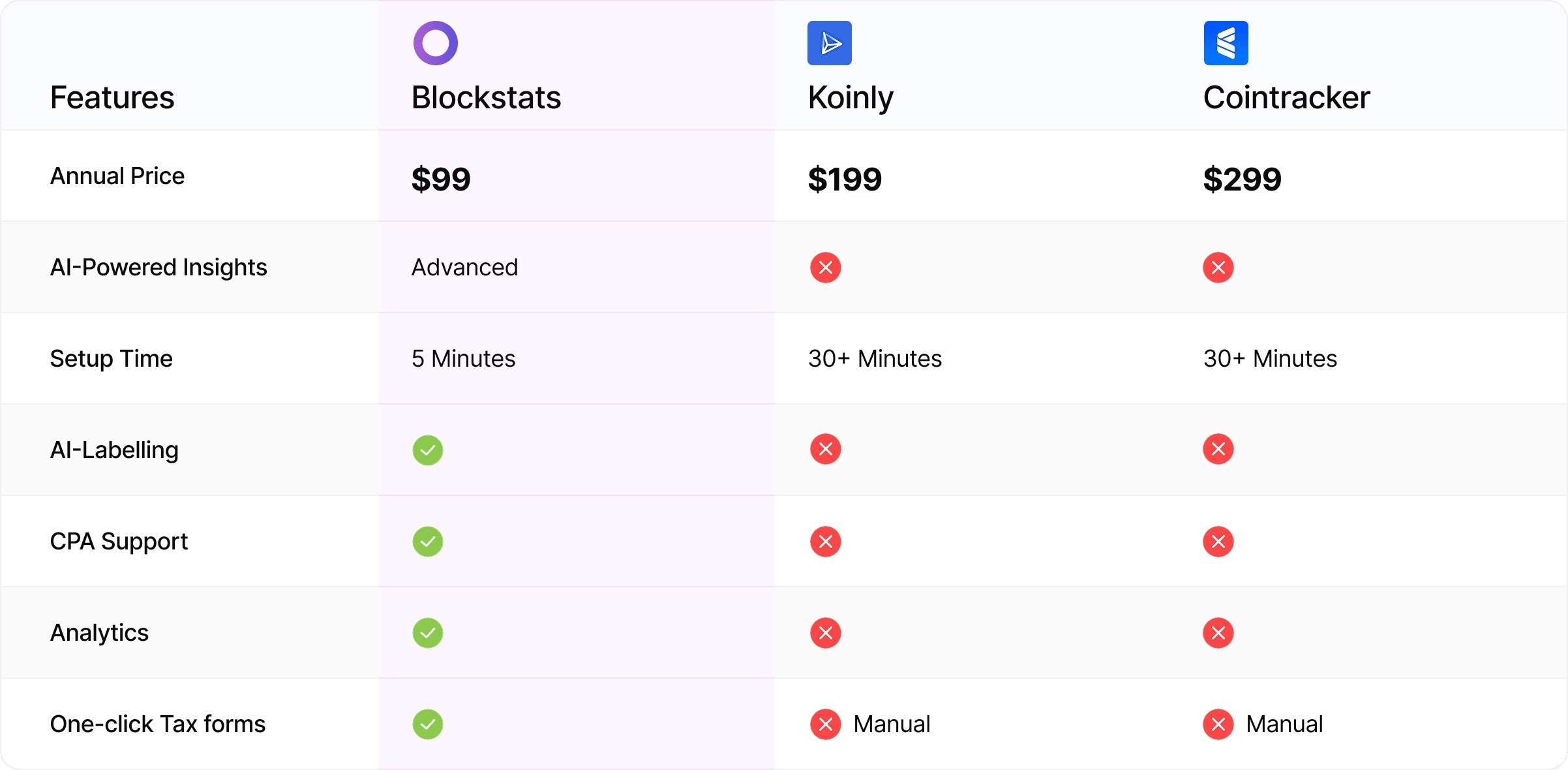
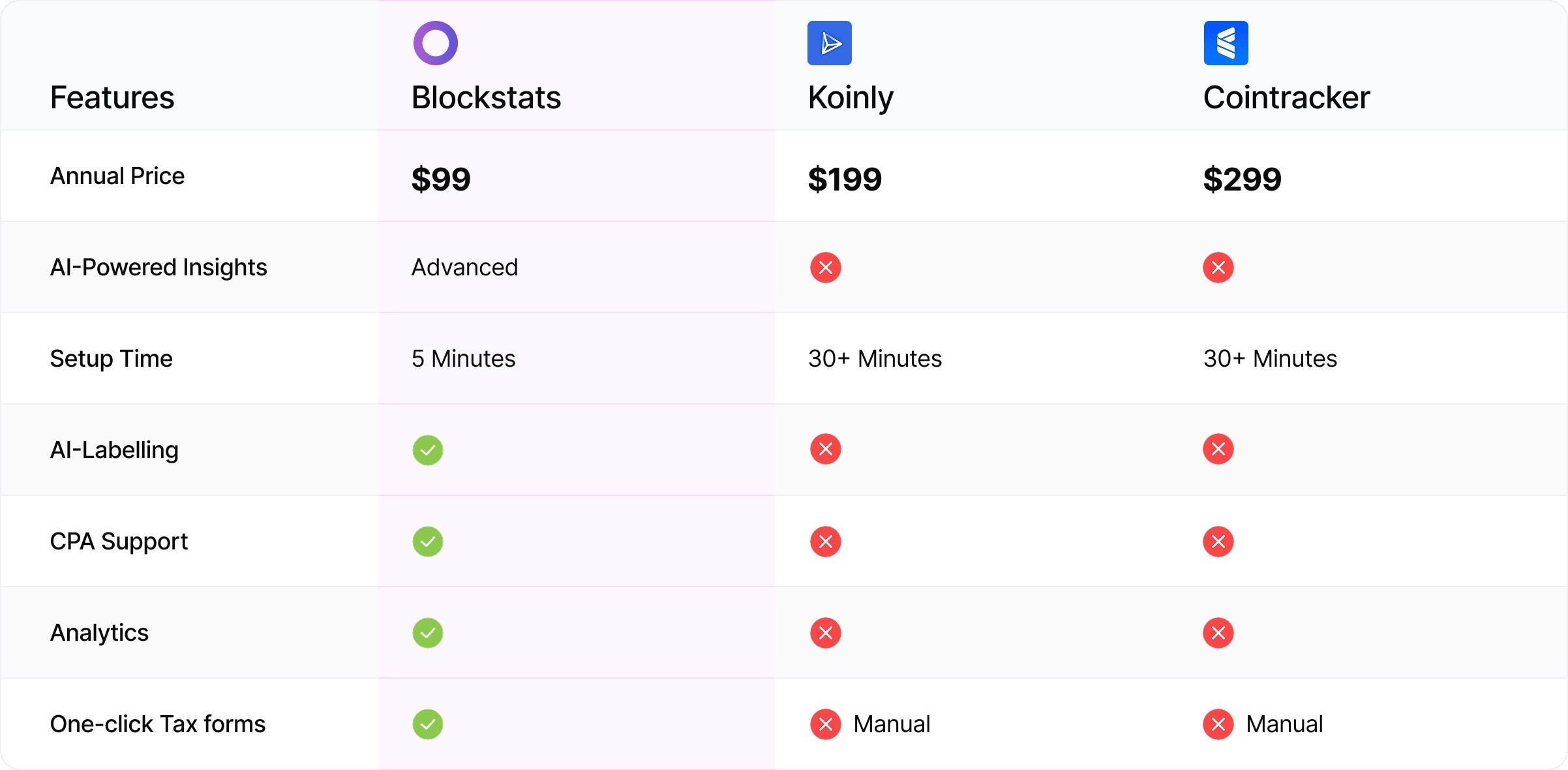
There’s also a Full-Service plan where their team does the work for you (done-for-you filing), which is priced higher. Blockstats markets itself as offering more for $99 than competitors, and you can start free with no credit card. Always confirm the current price and exactly which transaction limits each tier covers on the live site before you pay, since these can change.
5. Pros & Cons
Pros: Fast setup and import; AI categorization saves real time; IRS Form 8949, Schedule D, and TurboTax support; free report to preview before paying; dedicated accountant tools; portfolio tracking bundled in.
Cons: Tax-form output still needs your review for accuracy; AI categorization isn’t perfect (~95% claimed); pricing scales with transaction volume so heavy traders pay more; primarily oriented toward US/IRS filing.
6. Blockstats vs Koinly
Koinly is one of the best-known crypto tax platforms with very broad exchange support and a long track record. Blockstats competes on speed and price — leaning on AI categorization and a “file in 30 minutes” pitch, plus a full-service done-for-you option and dedicated accountant workflows. If you want the most mature, widely-integrated option, Koinly is the safe pick; if you want a faster, cheaper flow with an option to hand it off entirely, Blockstats is worth a look. Both let you preview before paying, so trying each with your own data is the honest way to decide.
7. Final Verdict: Is Blockstats Worth It in 2026?
For active traders and multi-wallet users, Blockstats does the thing that matters most: it turns a weekend of spreadsheet misery into a short session. The free report means you can see your numbers before spending a cent, which removes most of the risk of trying it. It won’t replace a tax professional’s judgment, and you should always review the generated forms, but as a time-saver it’s a solid, fairly-priced option for 2026.
Frequently Asked Questions
Does Blockstats support IRS tax forms?
Yes — it generates Form 8949 and Schedule D and exports to TurboTax.
Is there a free version of Blockstats?
Yes, there’s a free tier and a free report so you can preview your tax numbers before paying. No credit card is needed to start.
How much does Blockstats cost?
Paid plans I saw were Basic $69, Plus $119, and Pro $169 per tax year, with a higher-priced full-service option. Check the live site for current pricing and transaction limits.
Can accountants use Blockstats for clients?
Yes, there’s a dedicated accountant workflow with bulk reconciliation and cleanup tools for managing multiple clients.
Is Blockstats a substitute for a tax advisor?
No. It prepares forms from your data but does not provide personalized tax advice. Review the output and consult a professional for your specific situation.
👉 Where to Get Blockstats
You can start free (no credit card) and generate a preview report here: Get started with Blockstats.
Disclosure: This post contains an affiliate link. If you sign up through it, I may earn a commission at no extra cost to you. This article is for general information only and is not tax or financial advice — crypto tax rules vary by jurisdiction and by individual circumstance, so review all generated forms and consult a qualified professional before filing.